
Introduction
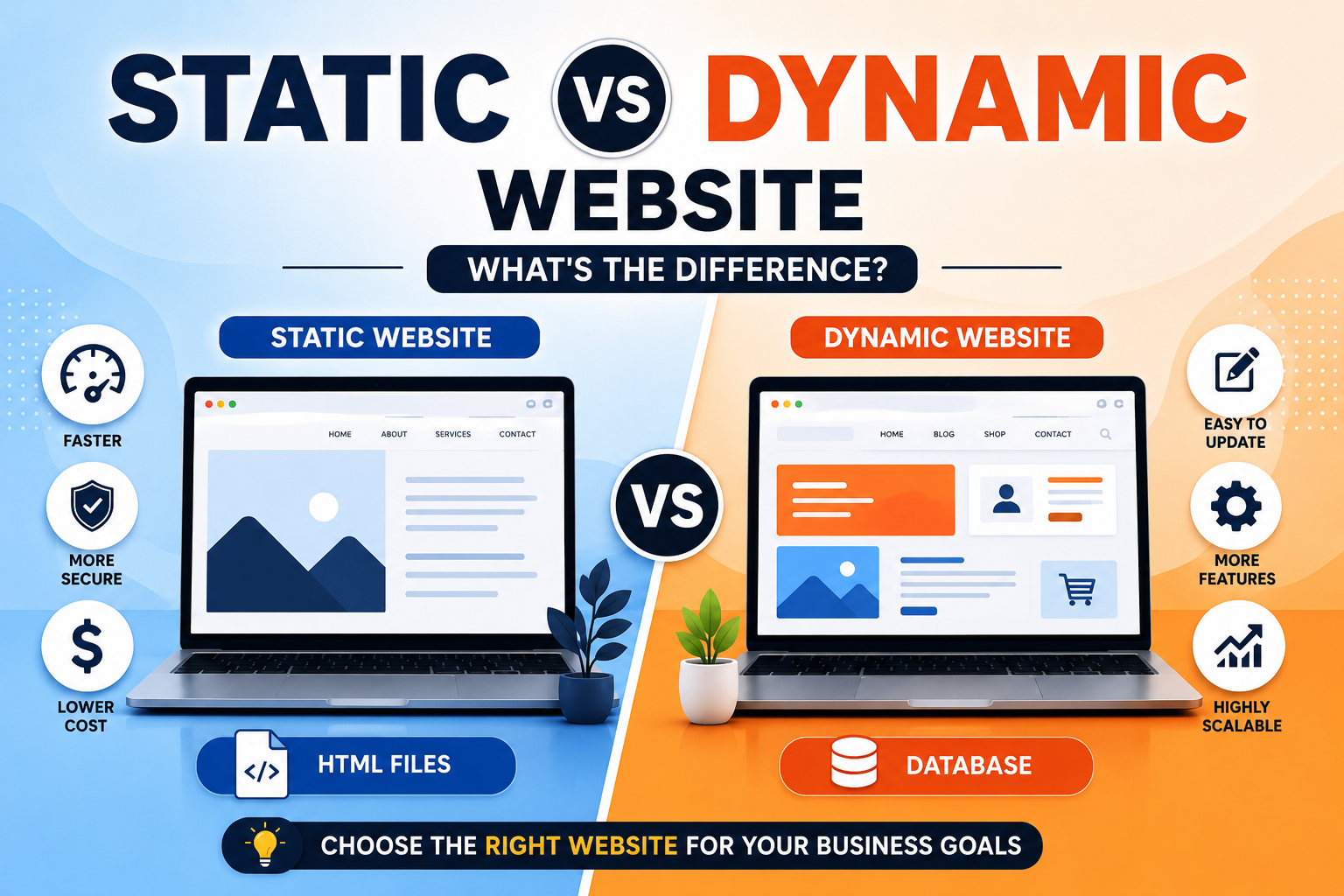
Static vs Dynamic Website is one of the most common comparisons people make before building a website. Choosing the right type is important because it affects your website’s speed, functionality, maintenance, scalability, and overall cost.
Whether you’re a business owner, startup founder, student, or developer, understanding the difference between a static website and a dynamic website will help you make the right decision.
In this guide, we’ll compare static vs dynamic websites, explain their advantages and disadvantages, and help you decide which option is best for your business in 2026.
Quick Comparison
| Feature | Static Website | Dynamic Website |
|---|---|---|
| Content | Fixed | Can change automatically |
| Database | Not Required | Required |
| Speed | Very Fast | Fast |
| Cost | Lower | Higher |
| Maintenance | Easy | Moderate |
| Best For | Small Businesses | Growing Businesses |
| User Login | Not Available | Available |
| Admin Panel | No | Yes |
| SEO | Excellent | Excellent |
| Scalability | Limited | High |
What is a Static Website?
A static website displays the same content to every visitor. Each page is created individually using technologies like HTML, CSS, and JavaScript, and the content remains unchanged unless someone manually edits the source files.
For example, if your business only needs a homepage, an about page, a services page, and a contact page, a static website is often a practical and cost-effective solution.
Common Examples
- Portfolio websites
- Company profile websites
- Landing pages
- Event websites
- Personal websites
Advantages of a Static Website
- Fast loading speed
- Lower development cost
- High security due to the absence of a database
- Easy hosting
- Excellent performance
- Suitable for small websites
Disadvantages of a Static Website
- Manual updates are required.
- No admin dashboard.
- Limited functionality.
- Difficult to scale for large projects.
- Not suitable for websites with frequent content updates.
What is a Dynamic Website?
A dynamic website generates content based on user requests. Instead of storing every page as a separate HTML file, it retrieves information from a database and displays it dynamically.
Popular platforms like WordPress, online stores, social media websites, and learning management systems are examples of dynamic websites.
Unlike a static website, a dynamic website allows you to update content through an admin dashboard without editing the code.
Common Examples
- WordPress websites
- eCommerce websites
- News portals
- School or college websites
- Coaching institute websites
- Booking systems
- Membership websites
Advantages of a Dynamic Website
- Easy content management
- Admin dashboard for updates
- User registration and login
- Search functionality
- Better scalability
- Supports advanced features and integrations
Disadvantages of a Dynamic Website
- Higher development cost
- Requires a database
- More regular maintenance
- Security updates are essential
- Can become slower if not optimized properly
Static Website vs Dynamic Website
1. Speed
Static websites generally load faster because the pages are pre-built.
Dynamic websites generate content on demand, but with modern optimization and caching, they can also deliver excellent performance.
Winner: Static Website
2. Cost
Static websites are more affordable because they involve less development work.
Dynamic websites cost more due to features such as databases, admin panels, and custom functionality.
Winner: Static Website
3. Flexibility
Static websites are ideal for fixed content.
Dynamic websites make it easy to update content, add pages, and introduce new features.
Winner: Dynamic Website
4. SEO
Both static and dynamic websites can perform well in search engines when they are properly optimized.
The quality of your SEO strategy matters far more than whether the website is static or dynamic.
Winner: Tie
5. Maintenance
Static websites require fewer updates.
Dynamic websites need regular maintenance, plugin updates, backups, and security monitoring.
Winner: Static Website
6. Scalability
Dynamic websites can grow alongside your business by supporting new features and increased traffic.
Static websites are better suited for smaller, less complex projects.
Winner: Dynamic Website
Which Website Should You Choose?
Choose a Static Website if you:
- Need a simple business website.
- Have a limited budget.
- Rarely update content.
- Want maximum speed.
Choose a Dynamic Website if you:
- Update content regularly.
- Need user accounts or logins.
- Plan to add blogs or products.
- Want an admin panel.
- Expect your website to grow over time.
Our Recommendation
For most modern businesses, a dynamic website is the better long-term investment. It offers greater flexibility, easier content management, and room to scale as your business grows.
However, if your needs are straightforward and your content rarely changes, a static website can be an excellent, cost-effective choice.
The best option depends on your business goals, budget, and future plans.
Frequently Asked Questions (FAQ’s)
1. Which is faster: a static or dynamic website?
Static websites are generally faster because the pages are served directly without querying a database.
2. Is WordPress a static or dynamic website?
WordPress is a dynamic content management system that stores and displays content from a database.
3. Which website type is better for SEO?
Both can achieve excellent SEO results. Factors like content quality, site speed, mobile responsiveness, and optimization have a greater impact than the website type itself.
4. Which website is best for small businesses?
A static website is suitable for businesses with basic information, while a dynamic website is a better choice for businesses that expect to grow or update content frequently.
5. Can a static website be converted into a dynamic website?
Yes. A static website can later be rebuilt or migrated to a dynamic platform such as WordPress or another CMS.