
Introduction
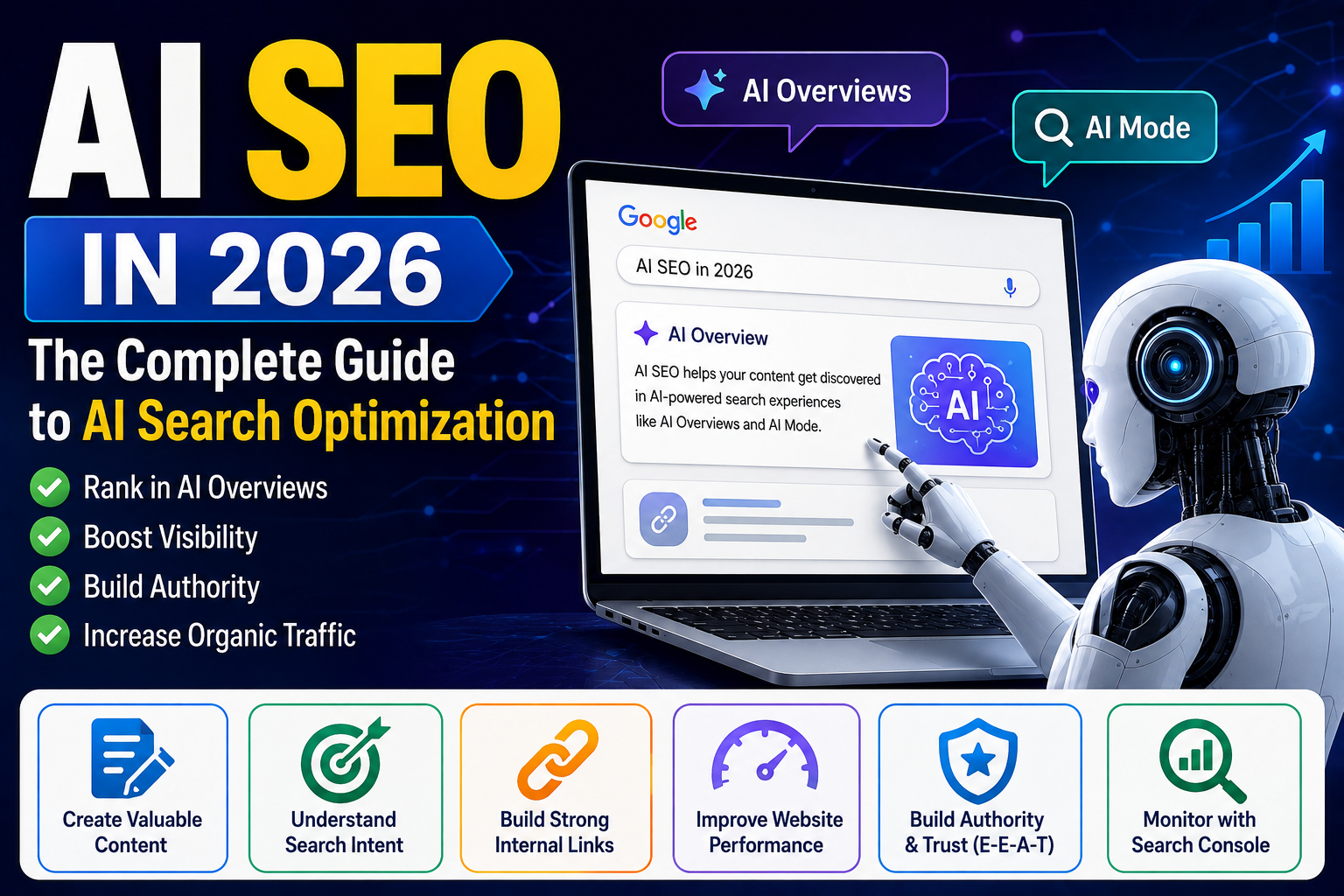
AI SEO in 2026 is changing how businesses approach search engine optimization. Google Search is increasingly using AI experiences such as AI Overviews and AI Mode to help users explore complex questions and discover relevant websites.
However, AI SEO isn’t about replacing traditional SEO with a completely new system. It builds on the same fundamentals explained in our What is SEO? guide. Google’s current guidance confirms that the fundamental SEO practices that help pages appear in Search also remain important for AI-powered search experiences.
For businesses, this means creating useful content, maintaining a technically healthy website, building authority, and providing information that genuinely helps users.
In this guide, you’ll learn what AI SEO means, how AI search works, and what you can do in 2026 to improve your website’s visibility.
Quick AI SEO Checklist
✅ Create original, useful content
✅ Understand search intent
✅ Answer questions clearly
✅ Use descriptive headings
✅ Build strong internal links
✅ Keep important content in text
✅ Improve website speed
✅ Make your website mobile-friendly
✅ Build genuine authority
✅ Monitor Google Search Console
What is AI SEO?
AI SEO is the process of optimizing your website so that your content can be discovered, understood, and potentially surfaced within AI-powered search experiences as well as traditional search results.
Google’s AI experiences include AI Overviews and AI Mode, which can provide generated responses along with links to supporting websites. Google provides an overview of how AI features work in Search and how website owners can approach them.
The important point is that AI SEO is not a replacement for SEO. It builds on the same fundamentals:
- Helpful content
- Technical SEO
- Internal linking
- Search intent
- Website performance
- Authority
- Trust
How AI Search Works
AI-powered search can use multiple searches and sources to develop an answer.
Google describes a process called query fan-out, where AI search can issue multiple related searches across subtopics and data sources before generating a response.
This creates an opportunity for websites that provide useful, specific information on different aspects of a topic.
For example, instead of targeting only:
“Website development”
You could create useful content covering:
- Website development cost in Jaipur
- Website development process
- Website technologies
- Website maintenance
- Website security
- Website redesign
This creates a deeper content ecosystem around the main topic.
AI SEO vs Traditional SEO
| Traditional SEO | AI SEO |
|---|---|
| Focuses on search rankings | Focuses on visibility across AI search experiences |
| Targets keywords | Focuses more strongly on topics and user questions |
| Optimizes individual pages | Builds connected content ecosystems |
| Builds backlinks | Builds authority and useful references |
| Optimizes for search results | Also considers AI-generated responses |
Important: These aren’t two completely separate SEO strategies. Traditional SEO remains the foundation for AI search visibility.
7 Ways to Improve AI SEO in 2026
1. Create Original Content
Don’t simply rewrite information that already exists online.
Add something useful:
- Your own experience
- Examples
- Case studies
- Original research
- Data
- Screenshots
- Practical recommendations
Google’s guidance emphasizes creating valuable, unique, people-first content for generative AI search.
2. Answer Specific Questions
AI search often handles complex and conversational questions.
Instead of creating a page targeting only:
“SEO”
Create useful sections answering questions such as:
- What is SEO?
- How does SEO work?
- How long does SEO take?
- How much does SEO cost?
- What are common SEO mistakes?
This also makes your content easier for readers to navigate.
3. Build Topic Authority
Don’t publish one article and stop.
Create related content around your main topic.
For example, your SEO cluster can include:
- What is SEO?
- Keyword Research Guide
- On-Page SEO Guide
- Off-Page SEO Guide
- Technical SEO Guide
- Local SEO Guide
- SEO Audit Checklist
- How Google Ranks Websites
- Core Web Vitals Guide
- Image SEO Guide
Connect these articles using relevant internal links.
4. Improve Technical SEO
AI search still needs to discover and process your website.
Make sure:
- Important pages can be crawled
- Pages are indexable
- Internal links are clear
- Important information is available as text
- Your website works on mobile
- Pages load efficiently
- Structured data matches visible content
Google specifically recommends maintaining strong technical foundations for generative AI features.
5. Demonstrate E-E-A-T
Your content should demonstrate:
Experience
Show real-world experience.
Expertise
Explain topics accurately.
Authoritativeness
Build recognition within your industry.
Trustworthiness
Provide transparent and reliable information.
For your business website, this can include:
- Author information
- About page
- Contact information
- Business details
- Reviews
- Case studies
- Original examples
6. Use Structured Content
Make your content easy to understand.
Use:
- Clear H2 headings
- Short paragraphs
- Lists
- Tables
- FAQs
- Examples
- Step-by-step instructions
Don’t write specifically for an AI system. Write content that is easy for humans to understand first.
7. Keep Your Business Information Updated
For local businesses, keep important information accurate across your website and Google Business Profile.
Check:
- Business name
- Address
- Phone number
- Opening hours
- Services
- Photos
- Reviews
Google’s AI search guidance specifically recommends keeping Business Profile information up to date.
Does AI-Generated Content Help SEO?
AI itself isn’t automatically good or bad for SEO.
Google’s current guidance says generative AI can be useful for research, structure, and content creation. However, generating many pages primarily to manipulate search rankings or publishing low-value content at scale can violate Google’s spam policies.
The better approach is:
AI + Human Expertise + Original Value
Use AI to assist with:
- Research
- Brainstorming
- Outlines
- Editing
- Content organization
Then add your own:
- Experience
- Examples
- Data
- Insights
- Expertise
- Fact-checking
Do You Need AEO or GEO for AI Search?
You’ll often see terms such as AEO (Answer Engine Optimization) and GEO (Generative Engine Optimization).
These terms can be useful when discussing strategies for AI-powered search, but don’t treat them as secret Google ranking systems.
Google’s own guidance says there are no additional technical requirements or special optimizations needed to appear in AI Overviews or AI Mode. You can read Google’s official guidance on AI features and your website for more information.
So don’t waste time looking for:
❌ Secret AI markup
❌ Special AI files
❌ Guaranteed GEO tools
❌ AI ranking hacks
Instead, focus on strong SEO fundamentals and genuinely useful content.
How to Measure AI SEO Performance
Google recommends using Google Search Console to monitor search performance. AI-feature traffic is included in the overall Search Console Performance reporting, and Google began rolling out dedicated generative-AI performance views in 2026.
Monitor:
- Impressions
- Clicks
- CTR
- Search queries
- Top-performing pages
- Organic conversions
- AI-search visibility, where available
Learn how to monitor your website’s search performance with our Google Search Console Guide.
Common AI SEO Mistakes
❌ Publishing hundreds of AI-generated pages – Google considers generating many pages primarily to manipulate rankings and without adding value to users a form of scaled content abuse.
❌ Copying competitor content
❌ Writing only for search engines
❌ Keyword stuffing – (Many of these problems are also covered in our Common SEO Mistakes guide.)
❌ Creating generic AI content
❌ Ignoring technical SEO
❌ Ignoring user intent
❌ Publishing outdated information
❌ Believing every GEO/AEO tool claim
❌ Expecting instant results
AI SEO Best Practices for 2026
Focus on this simple formula:
Useful Content + Technical SEO + Experience + Authority + Trust + Continuous Improvement
AI search is evolving quickly, but the fundamentals remain remarkably consistent.
Conclusion
AI SEO in 2026 is not about finding a shortcut to appear in AI-generated answers. It is about creating content that search engines can discover, understand, and confidently use as a useful source.
Build technically sound websites, publish original information, answer real questions, demonstrate experience, and create a strong network of related content. Learn more about Technical SEO, E-E-A-T, and How Google Ranks Websites in our detailed guides.
Most importantly, don’t abandon traditional SEO. Google’s current guidance confirms that SEO fundamentals remain the foundation for visibility in AI-powered search experiences.
Frequently Asked Questions (FAQs)
1. What is AI SEO?
AI SEO is the process of improving a website’s visibility across traditional search and AI-powered search experiences such as Google AI Overviews and AI Mode.
2. Is AI SEO different from traditional SEO?
AI SEO builds on traditional SEO. Technical SEO, helpful content, internal linking, indexing, and website quality remain important.
3. Does AI-generated content rank on Google?
AI-generated content can appear in Google Search, but content created primarily to manipulate rankings or generated at scale without adding value can violate Google’s spam policies.
4. Do I need special schema for AI search?
No. Google says there is no special schema or AI-specific markup required for AI Overviews or AI Mode.
5. How can I improve my chances of appearing in AI search?
Create original, helpful content, maintain strong technical SEO, use clear internal linking, demonstrate experience and expertise, and make important information accessible to search engines.
6. What are AEO and GEO?
AEO generally refers to Answer Engine Optimization, while GEO commonly refers to Generative Engine Optimization. These are industry terms for optimizing content for AI-driven answer experiences, but they shouldn’t be treated as guaranteed Google ranking systems.