
Introduction
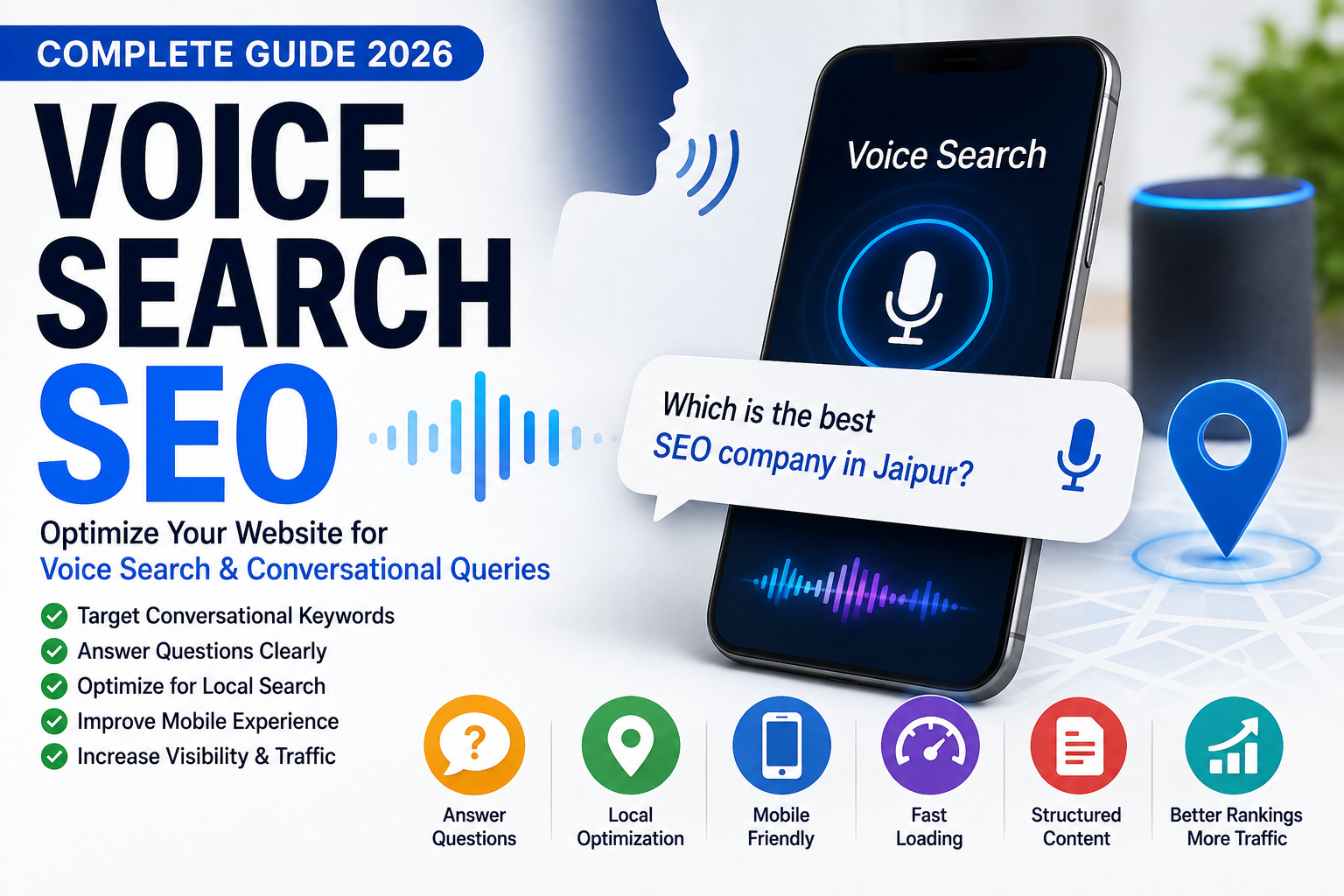
Voice Search SEO helps businesses optimize their websites for people who search using spoken questions instead of typing traditional keywords.
Instead of searching:
SEO services Jaipur
A user may ask:
“Which is the best SEO company in Jaipur?”
Voice searches are often more conversational and question-based. This makes it important to understand how people naturally speak when searching for information.
Voice search also overlaps with mobile search, local search, and newer AI-powered search experiences. Google has specifically noted that Search has evolved to handle voice queries and other multimodal searches.
In this guide, you’ll learn how Voice Search SEO works, how to find conversational keywords through Keyword Research, and how to optimize your website for voice-based searches.
Quick Voice Search SEO Checklist
✅ Target conversational keywords
✅ Answer common questions
✅ Use long-tail keywords
✅ Optimize for local searches
✅ Make your website mobile-friendly
✅ Improve page speed
✅ Use clear headings
✅ Provide concise answers
✅ Keep business information updated
✅ Improve overall SEO
What is Voice Search SEO?
Voice Search SEO is the process of optimizing website content so it can better serve users who search through voice-enabled devices.
Users may search through:
- Smartphones
- Smart speakers
- Cars
- Voice assistants
- Other connected devices
Instead of typing short phrases, users often speak complete questions or sentences.
For example:
Typed search:
Website development Jaipur
Voice search:
“Where can I find website development services in Jaipur?”
Why is Voice Search SEO Important?
Voice search optimization can help businesses:
- Reach conversational search queries
- Improve local visibility
- Answer customer questions
- Reach mobile users
- Improve user experience
- Capture long-tail search traffic
However, Voice Search SEO should not be treated as a completely separate SEO system. Strong technical SEO, useful content, relevant keywords, and good website experience remain important.
How Voice Search is Different
Traditional Search
Users might type:
best digital marketing course Jaipur
Voice Search
A user might ask:
“What is the best digital marketing course in Jaipur?”
Voice queries are often:
- Longer
- More conversational
- Question-based
- Location-specific
- More natural
This means your content should reflect the way people actually speak.
7 Ways to Optimize for Voice Search
1. Target Conversational Keywords
Instead of focusing only on short keywords, include natural phrases.
Examples:
Short keyword:
SEO course Jaipur
Conversational keyword:
“Where can I learn SEO in Jaipur?”
Create content that naturally answers both variations. Learn more about finding the right keywords in our Keyword Research Guide.
2. Answer Common Questions
Voice searches frequently take the form of questions.
Create sections answering:
- What?
- Why?
- How?
- Where?
- When?
- Which?
For example:
What is SEO?
Give a direct and easy-to-understand answer before expanding on the topic.
3. Use Long-Tail Keywords
Long-tail keywords are especially useful for conversational searches.
Examples:
- How much does website development cost in Jaipur?
- How can I improve my Google rankings?
- Where can I learn digital marketing in Jaipur?
- How long does SEO take?
These searches are more specific and can match user intent more closely.
4. Optimize for Local Search
Voice searches are often useful when users want nearby businesses.
Examples:
“Web development company in Jaipur“
“Digital marketing course near me”
Make sure your website clearly provides:
- Business name
- Location
- Phone number
- Services
- Opening hours
- Contact information
For local businesses, maintaining accurate business information is especially important. Learn more about improving your local visibility in our Local SEO Guide.
5. Create a Strong FAQ Section
FAQs can help you answer common customer questions in a clear format.
For example:
Question:
How much does website development cost in Jaipur?
Answer:
Website development costs vary depending on the number of pages, features, design requirements, and technology used.
Keep answers:
- Clear
- Direct
- Accurate
- Helpful
Don’t create FAQs simply to target keywords. FAQs should be useful to visitors and fit naturally into your overall On-Page SEO strategy.
6. Improve Mobile Experience
Many voice searches happen through mobile devices.
Your website should:
- Load quickly
- Work on small screens
- Have readable text
- Use easy navigation
- Have clearly visible buttons
- Provide a good user experience
Mobile optimization is therefore an important part of a broader SEO strategy. Website performance also matters for user experience. Learn more in our Core Web Vitals Guide.
7. Improve Website Speed
A slow website creates a poor experience regardless of how users reach your website.
Optimize:
- Images
- CSS
- JavaScript
- Caching
- Server performance
- Page size
Image optimization is one practical way to improve page performance. See our Image SEO Guide for image optimization techniques.
Voice Search Keyword Research
When researching voice-search keywords, think about how your customers speak, not just what they type.
Start with question phrases such as:
What
What is SEO?
How
How does SEO work?
Where
Where can I learn digital marketing?
Which
Which website development company is best?
Near Me
SEO company near me
These can become headings, FAQs, or sections within your content.
Voice Search and Local SEO
Voice Search SEO is particularly useful for local businesses.
For example, someone may ask:
“Where can I find a web development company near me?”
Your website should clearly communicate:
Who you are + What you offer + Where you are located.
For a local business, this means maintaining accurate business information and a strong local SEO presence. For a complete local search strategy, see our Local SEO Guide.
Voice Search vs Traditional Search
| Traditional Search | Voice Search |
|---|---|
| Usually shorter | Often conversational |
| Keyword-focused | Question-focused |
| Typed queries | Spoken queries |
| Often fewer words | Often longer phrases |
| Can be broad | Often specific |
Common Voice Search SEO Mistakes
❌ Targeting only short keywords
❌ Ignoring conversational language
❌ Writing unnatural content
❌ Ignoring local SEO
❌ Poor mobile experience
❌ Slow website
❌ Hiding important information
❌ Creating unnecessary FAQ pages
❌ Keyword stuffing
❌ Expecting a separate “voice SEO” ranking trick
Does Voice Search Need Special Schema?
There is no magic “voice search schema” that guarantees visibility.
Instead, focus on accurate structured data where it genuinely applies, clear content, crawlability, and strong overall SEO.
Google’s current guidance for AI-powered Search similarly emphasizes foundational SEO rather than special optimization tricks.
How to Measure Voice Search SEO
Voice-search performance can be difficult to isolate because Google Search Console does not provide a simple universal “voice search traffic” filter.
Instead, monitor:
- Search queries
- Long-tail keywords
- Question-based queries
- Local searches
- Impressions
- Clicks
- CTR
- Organic conversions
Google Search Console can help you understand the queries bringing users to your website.
Voice Search SEO Best Practices for 2026
Focus on this simple formula:
Natural Language + Helpful Answers + Local Relevance + Mobile Experience + Strong SEO
Don’t create content only because you think it might be spoken through a voice assistant.
Create content that genuinely answers the questions your customers ask.
Conclusion
Voice Search SEO is becoming increasingly connected with conversational and mobile search. The best strategy isn’t to chase a special voice-search ranking trick but to understand how your audience asks questions and create useful content that provides clear answers.
Focus on conversational keywords, question-based content, local SEO, mobile usability, website speed, and strong SEO fundamentals.
As search continues to evolve toward AI-powered and multimodal experiences, websites that consistently provide useful and trustworthy information will be better positioned to reach users across different search experiences.
As search continues to evolve toward AI-powered and multimodal experiences, understanding AI SEO in 2026 can help businesses prepare for changing search behavior.
Frequently Asked Questions
1. What is Voice Search SEO?
Voice Search SEO is the process of optimizing website content to better serve users who search using spoken queries.
2. How do I optimize my website for voice search?
Use conversational keywords, answer common questions, optimize for local searches, improve mobile usability, and create clear, helpful content.
3. Are long-tail keywords important for voice search?
Yes. Conversational voice searches are often longer and more specific than traditional typed searches.
4. Is Voice Search SEO different from regular SEO?
Not completely. Voice Search SEO builds on traditional SEO fundamentals such as useful content, technical SEO, mobile usability, and search intent.
5. Does voice search need special schema?
No special schema guarantees voice-search visibility. Use structured data when it accurately represents your page content and follow Google’s general SEO guidelines.
6. How can I find voice-search keywords?
Look for question-based and conversational queries using keyword research tools, Google Search Console, Google autocomplete, and questions your customers frequently ask.