
Introduction
Common SEO Mistakes can prevent even a well-designed website from achieving strong search engine rankings. Many website owners focus on publishing content but overlook essential SEO practices such as keyword research, technical optimization, internal linking, and website performance. If you’re new to SEO, start by learning the fundamentals in our What is SEO? guide before avoiding these common mistakes.
Even small mistakes can reduce your visibility, lower organic traffic, and make it difficult for search engines to understand your website.
The good news is that most SEO mistakes are easy to identify and fix. By understanding these common issues and following proven SEO best practices, you can improve your website’s performance and increase your chances of ranking higher on Google.
In this guide, you’ll discover the most common SEO mistakes, why they matter, and how to avoid them.
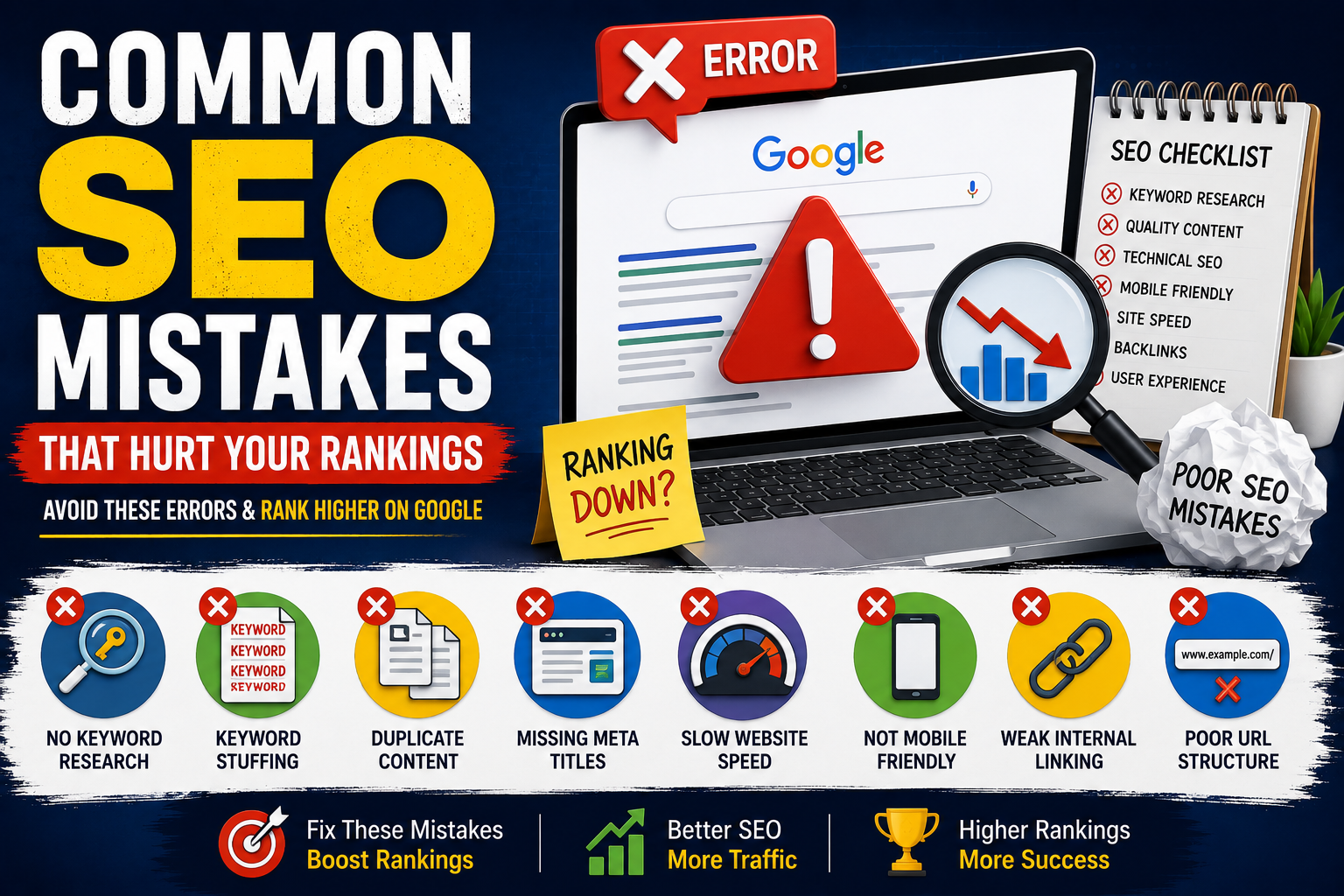
Quick SEO Mistakes Checklist
❌ Skipping keyword research
❌ Keyword stuffing
❌ Duplicate content
❌ Missing meta titles
❌ Poor meta descriptions
❌ Slow website speed
❌ No mobile optimization
❌ Weak internal linking
❌ Poor URL structure
❌ Ignoring technical SEO
What Are SEO Mistakes?
SEO mistakes are errors that reduce your website’s ability to rank well in search engines. They can affect how search engines crawl, index, understand, and rank your content.
Some mistakes impact technical performance, while others affect content quality or user experience.
25 Common SEO Mistakes
1. Skipping Keyword Research
Publishing content without proper keyword research often results in targeting topics that people aren’t searching for.
How to Fix? –Perform proper keyword research before creating any content. Our Keyword Research Guide explains how to find keywords with the right search volume, intent, and competition.
2. Keyword Stuffing
Using the same keyword repeatedly makes content unnatural and can negatively affect rankings.
3. Ignoring Search Intent
Creating content that doesn’t match what users are actually looking for often leads to high bounce rates. Understanding search intent is one of the most important parts of On-Page SEO.
4. Poor Title Tags
Titles should be unique, descriptive, and include your primary keyword.
5. Weak Meta Descriptions
A compelling meta description improves click-through rates.
6. Duplicate Content
Duplicate pages confuse search engines and reduce SEO value.
7. Poor Heading Structure
Always use one H1 and organize content with H2 and H3 headings.
8. Slow Website Speed
A slow website negatively affects both user experience and rankings. Improving website speed is a core part of Technical SEO and regular website maintenance. You can measure your website’s loading performance using Google PageSpeed Insights.
9. Ignoring Mobile Users
Your website should be fully responsive on all devices.
10. Missing Image ALT Text
ALT text helps search engines understand images and improves accessibility.
11. Broken Internal Links
Broken links create a poor user experience and waste crawl budget. Regular website audits help identify broken links before they affect your SEO performance.
12. Weak Internal Linking
Link related pages naturally to help users and search engines navigate your website. A strong internal linking strategy also helps Google understand How Google Ranks Websites and distributes authority across your pages.
13. Poor URL Structure
Keep URLs short, descriptive, and keyword-focused.
14. Ignoring HTTPS
A secure website builds trust and supports SEO. Follow our Website Security Best Practices to improve your website’s security and protect user data.
15. Missing XML Sitemap
Without a sitemap, search engines may not discover all important pages. XML sitemaps help search engines discover your pages and are an important part of Technical SEO.
16. Incorrect robots.txt
Blocking important pages by mistake can prevent them from being indexed.
17. No Schema Markup
Structured data helps search engines better understand your content.
18. Poor Content Quality
Thin, outdated, or low-value content rarely performs well.
19. Buying Backlinks
Low-quality backlinks can lead to Google penalties. Learn how to build natural, high-quality backlinks in our Off-Page SEO Guide.
20. Ignoring Local SEO
Businesses serving specific locations should optimize for local searches. If you serve customers in a particular city or region, follow our Local SEO Guide to improve your local search visibility.
21. Not Updating Old Content
Refreshing content keeps it relevant and competitive.
22. Ignoring Core Web Vitals
Poor loading performance affects user experience. Core Web Vitals can be tested using Google PageSpeed Insights.
23. Not Using Google Search Console
Without Google Search Console, many SEO issues remain unnoticed. Learn how to use it effectively in our complete guide.
24. Never Performing an SEO Audit
Regular audits help identify and fix problems before they affect rankings. Use our complete SEO Audit Checklist to review your website regularly and fix issues before they affect your rankings.
25. Expecting Instant Results
SEO is a long-term strategy that requires consistency.
Biggest SEO Mistakes vs Best Practices
| SEO Mistake | Best Practice |
|---|---|
| No Keyword Research | Research Keywords First |
| Slow Website | Optimize Speed |
| Duplicate Content | Publish Original Content |
| Weak Internal Links | Link Related Pages |
| No SEO Audit | Audit Website Regularly |
Conclusion
A strong website combines quality content, proper keyword research, technical optimization, and a great user experience.
Avoiding common SEO mistakes is only one part of building a successful website. By combining Keyword Research, On-Page SEO, Technical SEO, and regular SEO Audits, you can improve your website’s visibility, user experience, and long-term search performance.
Frequently Asked Questions (FAQs)
1. What is the biggest SEO mistake?
Ignoring keyword research and publishing content without understanding user intent are among the biggest SEO mistakes.
2. Does keyword stuffing still work?
No. Keyword stuffing creates a poor user experience and may negatively impact rankings.
3. How often should I audit my website?
A complete SEO audit every 3–6 months is recommended for most websites.
4. Can slow website speed affect rankings?
Yes. Website speed is an important ranking factor and directly impacts user experience.
5. How can I avoid SEO mistakes?
Follow SEO best practices, monitor your website regularly, and use tools like Google Search Console to identify issues.