
Introduction
How Google Ranks Websites is one of the most common questions asked by website owners, bloggers, and businesses looking to improve their online visibility. Every day, Google processes billions of searches and determines which pages deserve to appear at the top of the search results.
Google doesn’t rank websites randomly. It uses advanced algorithms to crawl, index, and evaluate web pages based on hundreds of ranking signals, including content quality, relevance, website performance, backlinks, user experience, and technical optimization.
Understanding how this process works can help you build a website that meets Google’s quality standards and attracts more organic traffic. Before learning how Google ranks websites, it’s important to understand the fundamentals of Search Engine Optimization (SEO).
In this guide, you’ll learn how Google discovers websites, indexes content, evaluates ranking factors, and decides which pages appear in search results.
Quick Ranking Checklist
✅ Publish high-quality content
✅ Target the right keywords
✅ Improve page speed
✅ Make your website mobile-friendly
✅ Build quality backlinks
✅ Optimize On-Page SEO
✅ Improve Technical SEO
✅ Add internal links
✅ Secure your website with HTTPS
✅ Update content regularly
How Google Search Works
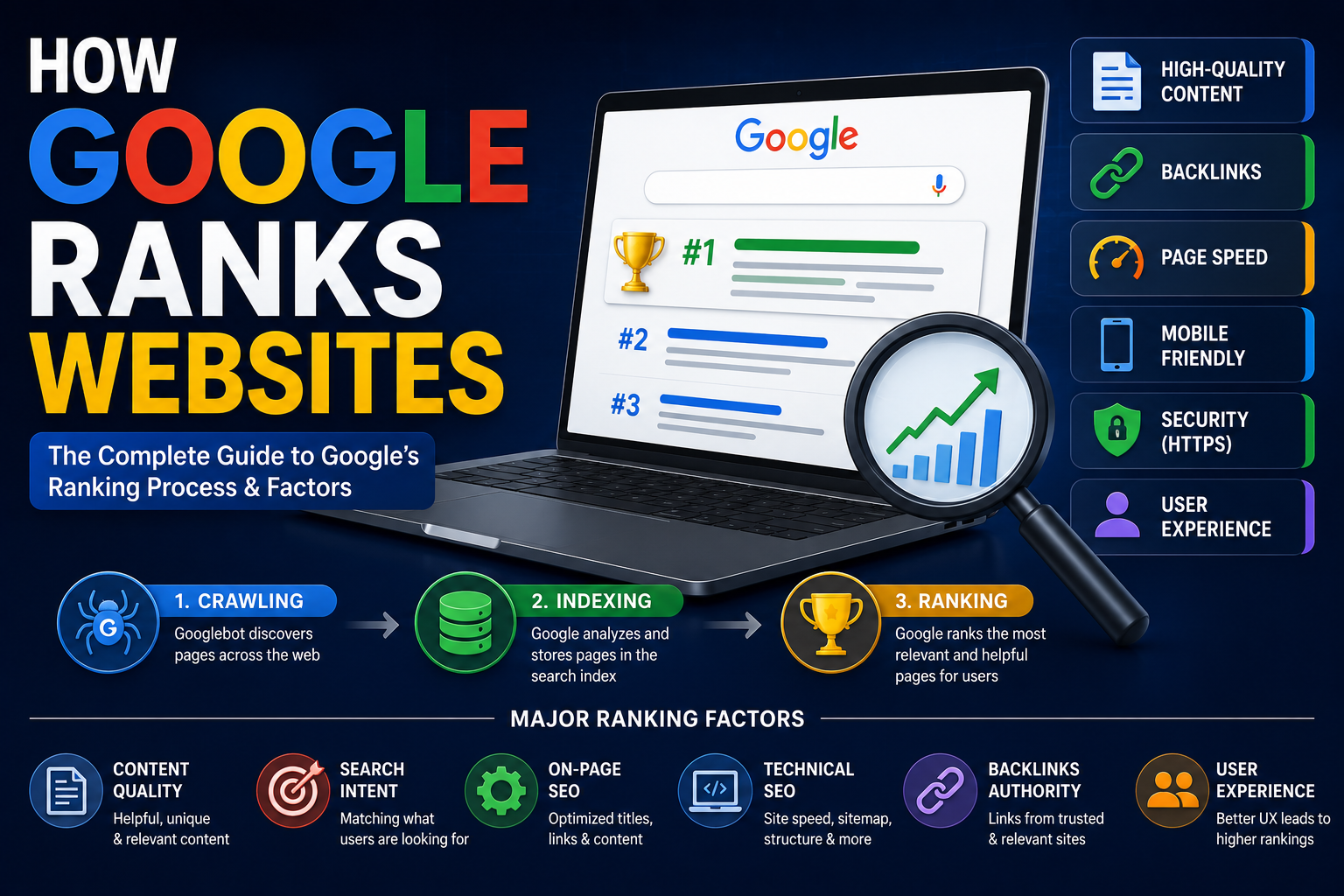
Google ranks websites in three main stages:
1. Crawling
Google uses automated programs called Googlebot to discover new and updated pages across the web. Google explains how crawling works in its official Google Search Central documentation. You can monitor how Google crawls and indexes your website using Google Search Console guide. These bots follow links from one page to another and collect information about your website.
2. Indexing
After crawling your website, Google analyzes your content and stores eligible pages in its search index. Pages that are not indexed cannot appear in Google Search results. You can verify whether your pages are indexed by using Google Search Console. Regularly checking indexing issues should be part of your SEO Audit Checklist.
3. Ranking
When someone performs a search, Google evaluates the indexed pages and ranks the most relevant, trustworthy, and helpful results based on hundreds of ranking signals.
Major Google Ranking Factors
1. High-Quality Content
Content should be:
- Original
- Helpful
- Accurate
- Well-structured
- Updated regularly
Google prioritizes content that genuinely answers users’ questions.
2. Search Intent
Your content should match what users are searching for.
Common search intents include:
- Informational
- Navigational
- Commercial
- Transactional
3. On-Page SEO
Optimize these optimizations are explained in detail in our On-Page SEO Guide.
- Title tags
- Meta descriptions
- Headings
- URLs
- Images
- Internal links
4. Technical SEO
Ensure your website has technical improvements like XML sitemaps, HTTPS, schema markup, and crawl optimization are covered in our Technical SEO Guide.
- Fast loading speed
- Mobile responsiveness
- XML sitemap
- HTTPS
- Clean URL structure
- Schema markup
5. Backlinks
Google considers links from trusted websites as votes of confidence. Learn how to build high-quality backlinks safely in our Off-Page SEO Guide.
Focus on earning:
- Relevant backlinks
- Editorial links
- Local citations
- Industry mentions
6. User Experience (UX)
Google values websites that provide a good experience.
Improve:
- Navigation
- Readability
- Mobile usability
- Page speed
- Accessibility
7. Core Web Vitals
Google measures:
- Largest Contentful Paint (LCP)
- Interaction to Next Paint (INP)
- Cumulative Layout Shift (CLS)
These metrics help evaluate real-world user experience. You can test your website’s Core Web Vitals using Google PageSpeed Insights.
8. Website Security
Secure websites using HTTPS are more trustworthy and provide a safer browsing experience. Google recommends using HTTP’s documentations to provide a secure experience for website visitors. A secure website improves user trust and supports better rankings. Follow our Website Security Best Practices to strengthen your site’s security.
9. Fresh Content
Regularly updating your content signals that your website remains accurate and relevant.
10. Internal Linking
A good internal linking structure helps search engines understand your website while making it easier for visitors to discover related content. Creating a strong internal linking strategy improves crawlability and helps distribute authority across your website.
Common Reasons Websites Don’t Rank
❌ Thin or duplicate content
❌ Slow loading speed
❌ Poor mobile experience
❌ Missing SEO optimization
❌ Weak backlink profile
❌ No indexing
❌ Broken internal links
❌ Poor user experience
Myths About Google Rankings
| Myth | Reality |
|---|---|
| More keywords mean higher rankings | Content quality matters more than keyword stuffing |
| Buying backlinks is safe | Low-quality paid links can lead to penalties |
| SEO delivers instant results | SEO requires consistent effort and time |
| More pages always rank better | Valuable, well-optimized pages perform better |
How to Improve Your Rankings
- Create helpful, original content
- Optimize every page for SEO
- Improve website speed
- Build quality backlinks
- Fix technical issues
- Add internal links
- Monitor Search Console
- Keep content updated
Conclusion
Google rankings improve when you combine high-quality content with On-Page SEO, Technical SEO, and Off-Page SEO best practices. Regular audits and continuous optimization help your website remain competitive in search results.
Google ranks websites by evaluating content quality, relevance, authority, technical performance, and user experience. There is no single ranking factor that guarantees success. Instead, websites that consistently provide valuable content, maintain strong technical health, and deliver an excellent user experience are more likely to perform well in search results.
Google’s official Search Essentials provide useful guidance on creating helpful, people-first content that performs well in search results.
Frequently Asked Questions (FAQs)
1. How does Google rank websites?
Google ranks websites by evaluating hundreds of signals, including content quality, relevance, backlinks, technical SEO, and user experience.
2. How long does it take to rank on Google?
Ranking time varies depending on competition, content quality, website authority, and SEO efforts. It often takes several weeks to several months.
3. Are backlinks still important?
Yes. High-quality backlinks remain one of the strongest ranking signals, especially when they come from trusted and relevant websites.
4. Does website speed affect rankings?
Yes. A fast-loading website improves user experience and is one of the factors Google considers when ranking pages.
5. Can I rank without SEO?
It is possible for some pages to rank naturally, but applying SEO best practices greatly improves your chances of achieving and maintaining strong search visibility.
2 thoughts on “How Google Ranks Websites (2026): Complete Beginner’s Guide”
Hi to all, how is the whole thing, I think every one is
getting more from this web site, and your views are nice in favor of
new users.
Incredible! This blog looks just like my old one! It’s on a totally different topic but it has
pretty much the same page layout and design. Outstanding choice of colors!